
 By David Robinson
Spend any amount of time reading about SEO, and you're bound to stumble across articles telling you to do keyword research. That's fine if you're selling shoes or holidays, where the search volumes are huge and the tools basically do the thinking for you. But if you're selling something specialist (subsea inspection services, bespoke industrial filtration systems, that sort of thing) the whole process feels a bit different, because the numbers are smaller, the terminology is more technical and the standard advice doesn't always apply.

We know this because we've been doing keyword research for niche B2B companies since 2003. Engineering firms, tech companies, oil and gas service providers, manufacturers of things most people have never heard of. The kind of businesses where a keyword with 30 monthly searches can be worth more than one with 3,000, because every single one of those 30 searchers is a genuine prospect with a genuine need. If that sounds like your world, you're in the right place.
What follows is our plain English guide to niche keyword research. We'll walk you through our actual process, share the tools we use, explain how to figure out which keywords are worth chasing and which ones are fool's gold, and try to save you from some of the mistakes we've seen (and made) over the years. If you're new to all of this, our plain English guide to SEO is worth a read first, but it's not essential.
Niche Keyword Research Takes Time
Digital marketers who rush their niche keyword research often end up optimising their content for phrases that matter to them – instead of the people they're trying to turn into customers. That leads to a very poor marketing ROI. It’s all too easy to assume that you know what people are searching for, and pour time and effort into pillar or landing pages that are fundamentally incapable of landing in front of your target audience because they’re optimised for phrases that nobody actually uses.
Content that’s “dead on arrival” as paramedics would say.
If you need a good example of that all-too common mistake, you need look no further than the Lush website. There’s a lot going on here, but it’s their vegan pages that we want to focus on. Someone’s obviously spent a lot of time creating specialised landing pages to help Lush attract new customers with a specific interest in vegan cosmetics.
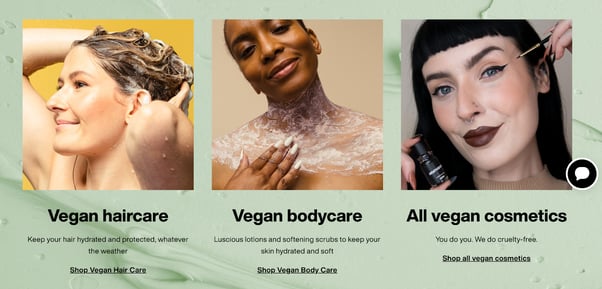
Thing is, they’ve optimised the pages for keywords that people just don’t use. Their page for vegan haircare is a good example: Elements like the title tag, page content and h1 tags are all optimised for the phrase “vegan hair products”
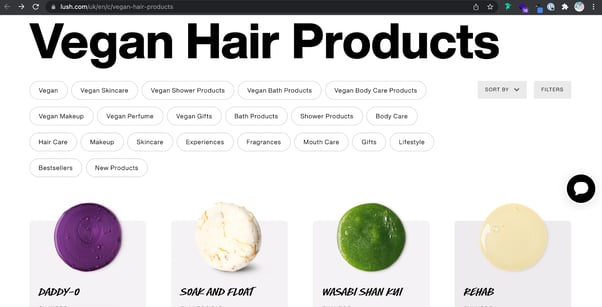
But “vegan hair products” is only Googled 2,400 times a month.
Meanwhile “vegan shampoo” is Googled approximately 12,400 times a month, but the current page stands no real chance of ranking for that phrase because it’s too busy chasing a keyword with 1/3rd of the search volume.
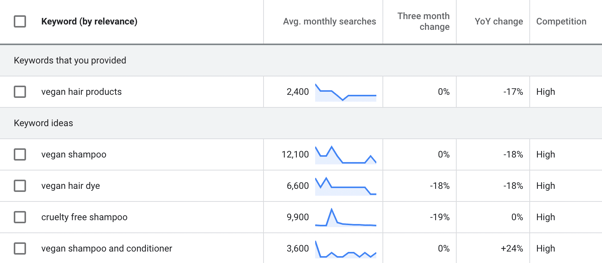
At 3,600 average monthly searches, even “vegan shampoo and conditioner” would have been a better fit than “vegan hair products”. But the sad reality is that Lush - like so many brands - skimped on their niche keyword research, made assumptions about their audiance, targeted the wrong phrase and nosedived their potential growth in favour of a phrase that made sense to industry insiders instead of the brands target audience.
Of course, this example raises several important questions: How are you actually supposed to do niche keyword research? What does it take to avoid these mistakes, and how am I supposed to start building a thorough understanding of the language my audience is using to search for products or services like mine?
To help you answer these questions, we’ve put together a painless guide to niche keyword research – using plain english to explain our own process, dispel some common myths and show you how to zero in on the phrases that’ll drive prospective customers to your website.
Start With The Most Obvious Keywords In Your Niche
Niche keyword research is best done with the help of automated tools like Google’s Keyword Planner, SEMRush or Ahrefs.
These tools track and record monthly search volumes for millions of different keywords, and they’re smart enough to suggest useful or related keywords to help guide your efforts but you still need a starting point: A handful of keywords that you can feed these tools to point them in the right direction. To find these niche keywords, log into Google' Keyword Planner (this is a free tool, and worth its weight in gold). Pick ‘find new keywords’ and you’ll be prompted to input a few search terms that relate to your core products or services.
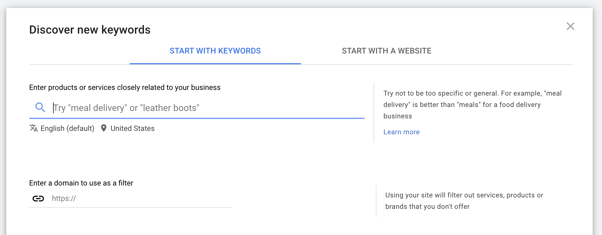
So to get things moving, try brainstorming five or six phrases that people are probably using to (try and) find your products or services. These don’t have to be correct. In fact, you’ll probably find that you’ve got them completely wrong but you’ve got to start somewhere and the automated tools we’re using here will quickly correct any mistakes.
Once you’ve got your list of ‘starter’ keywords, you can start plugging them into one or more of the following keyword tools:
Free or paid keyword tools that'll get the ball rolling
Keyword research tools have changed a fair bit in recent years, so here's an updated rundown of what we'd actually recommend in 2026:
- SEMRush (from $139/month) is still the tool we use most. It's expensive, but the keyword database is enormous, the competitive analysis features are really useful and the "Keyword Magic Tool" is particularly good for finding long-tail niche phrases. If you can only afford one paid tool, this is the one we'd pick.
- Ahrefs (from $129/month) is the other big player, and some SEOs prefer it to SEMRush. The "Keywords Explorer" tool is excellent and the difficulty scores tend to be a bit more conservative (which we actually prefer, because it gives you a more realistic picture of what you're up against).
- Google Keyword Planner is still free and still worth using, but bear in mind that Google rounds the search volumes into broad ranges unless you're spending money on Google Ads. It's a decent starting point, especially if you're on a tight budget.
- AlsoAsked (free for limited searches) is the PAA mining tool we mentioned earlier. Brilliant for finding questions your audience is asking, especially in niche markets where the standard keyword tools come up short.
- AnswerThePublic (free for limited searches, or from $11/month) visualises search questions and autocomplete suggestions. Similar to AlsoAsked but with a slightly different data set, so it's worth running both.
- Google Search Console is something you should already have set up on your website, and it's genuinely one of the most underrated keyword research tools available. It shows you the actual search queries that people are using to find your site, including the ones you're ranking on page two or three for. Those "almost there" keywords are often the easiest wins.
One thing worth mentioning: don't get too hung up on which tool gives you the "right" number. Type the same keyword into SEMRush and Ahrefs and you'll get different search volumes. That's normal, because they're working from different data sets. The numbers are directional, not gospel. What matters is the relative difference between keywords (this one gets roughly twice as much traffic as that one) rather than the exact figures.
When you type a keyword into Keyword Explorer, SEMRush or Keyword Planner, they’ll spit out a list of related search terms, alongside information about the number of times they’re searched per month, their competitiveness and rough approximation of the amount of work needed to rank a page for them.
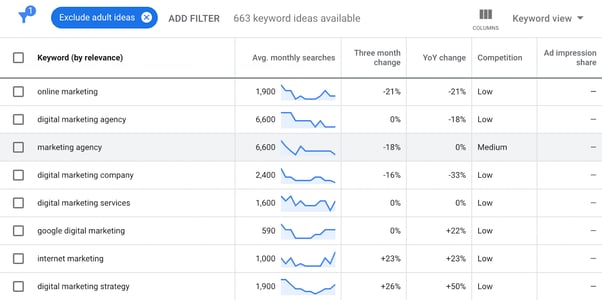
This data may feel fairly meaningless right now, but it’ll be key to building that list of high-value, niche keywords we talked about earlier.
In fact, the results pages provided by tools like SEMRush and Google Keyword Planner provide all the information you need to build an absolutely bulletproof keyword and content strategy but it is important to understand how to analyse the data they provide.
Metrics like “competitiveness” seem relatively self-explanatory, but they can be misleading and often lead you down the wrong track.
It’s also important to note that the data provided by keyword research tools is rarely 100% accurate. Type the same “seed phrase” or starting keyword into SEMRush and Moz Keyword Explorer and there’s a good chance both tools will spit out wildly divergent data.
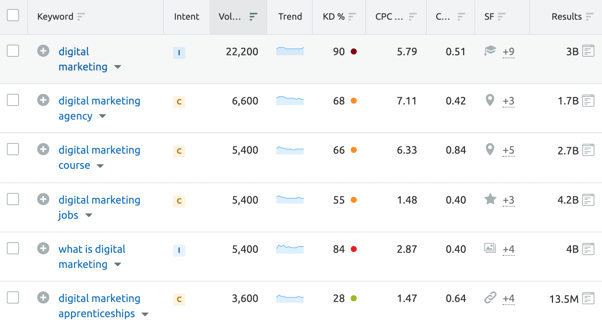
There are a few reasons for this - different tools have access to different data sets, some browsers like chrome obscure data for third party platforms and keyword tools are notoriously unreliable when it comes to collating data on low volume keyword searches.
But that’s not hugely important here. Using one or more keyword research tools will still provide you with a rough approximation of the relative popularity of various phrases, and that’s all we really need for now.
Once you’ve entered your seed keywords into the tool of your choice, download or copy/paste the results into a spreadsheet and we’ll get to work analysing the best targets for your future content campaign.
Mining Google's "People Also Ask" boxes
Here's a trick that costs nothing and takes about ten minutes, but it's one of the most useful things you can do when you're researching keywords for a niche market.
Go to Google, type in one of your seed keywords and scroll down until you see the "People Also Ask" box. You know the one, it's that expandable list of questions that Google thinks are related to your search. Each time you click on one of those questions, Google adds more questions to the list, so you can keep clicking and expanding until you've got dozens of real questions that real people are actually asking about your topic.
The reason this is so useful for niche markets is that keyword tools like SEMRush and Ahrefs sometimes struggle with specialist topics. They'll tell you that a phrase has zero or very low search volume, which might be technically true, but the People Also Ask boxes show you that people are still asking those questions. Google wouldn't surface them if nobody was searching for them.
There's a free tool called AlsoAsked (alsoasked.com) that automates this process, pulling all the PAA questions for a given search term into a nice visual map. It's worth bookmarking. You can take the questions it surfaces and plug them back into SEMRush or Keyword Planner to check the volumes, but honestly, even if the volumes come back low, these questions are gold for planning blog content because they tell you exactly what your audience wants to know.
We use this technique a lot when we're working with clients in specialist sectors, because it often surfaces questions and phrases that the keyword tools miss entirely. If you're selling something niche, the PAA boxes are one of the best free research tools available to you.
Don’t Get Too Hung Up On Search Volume
It’s important to point out that niche keyword research isn’t just about finding a big old list of high-volume keywords that you want to rank for Fundamentally, the purpose of any niche keyword research project is to hone in on keywords that are:
- Relevant for your business
- Used by your target audience (the target bit is key here)
- Indicative of someone who’s actively looking for products (or services) you offer
And this last point is key (pun fully intended). After all, there’s no benefit to ranking for a keyword that drives dozens of research students to your site, or precipitates a sudden influx of enquiries from people who clearly have no intention of actually engaging with your offering.
Instead, we want to pick keywords that people are actually using when they’re moving through the so-called “buying journey”. Which is to say ‘actively looking to learn more about a given service or product, refine their search for the same, or find a provider capable of supplying knowledge insight or guidance about a something they need’
To do this, we’ll need to weigh up quantitative data - like search volumes and competitiveness - against qualitative data about intent and audience so that you can zero in on keywords that are actually being used by the people you want to target.
In other words, we’ll be trying to go beyond the simple, surface metrics surrounding popularity and locate the phrases that’ll actually drive customers to your site.
As an example, let’s try typing ‘digital marketing’ into Google’s Keyword planner, so that we can start looking for some valuable keywords.
At first glance, “digital marketing” looks like the obvious keyword to target here: It’s searched for some 22,100 times a month. And that’s just in the UK.
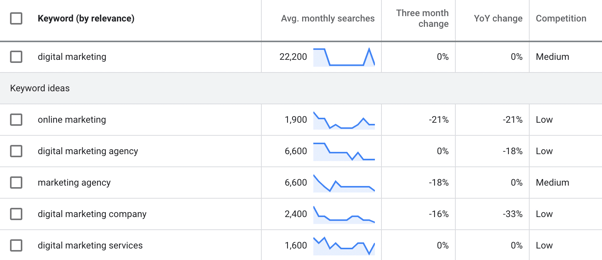
But it’s important to remember that there are many, many reasons to Google something vague and generic like ‘digital marketing’.
20% of those 22,100 people could be high school students, tasked with defining the term for an essay or test question, 10% could be people looking for digital marketing jobs and another 10-20% could easily be competitors Googling the phrase to see who’s currently ranking number one for their favourite vanity keyword.
Truth be told, time spent capturing that traffic would be time wasted, especially when you look at other, slightly less-trafficked niche keywords like “digital marketing services” which show much more intent to buy.
Why low-volume keywords matter more than you think
This is probably the single most important thing we can tell you about niche keyword research, so we're going to be blunt about it: if you're in a specialist B2B market and you're ignoring keywords because they "only" get 20 or 30 searches a month, you're leaving money on the table.
Here's why. Keyword research tools like SEMRush and Ahrefs estimate search volumes based on samples. For popular consumer keywords, those estimates are reasonably reliable. But for niche B2B keywords, especially long, technical phrases that only a few hundred people in the country would ever need to search for, the tools are often wildly inaccurate. A keyword showing "10 monthly searches" might actually be getting 50 or 60, but because the sample size is so small, the tools can't pin it down.
More importantly, think about who those 20 or 30 people are. If you're selling, say, industrial heat exchangers, and someone Googles "plate heat exchanger maintenance schedule", that's not a casual browser. That's someone who owns or operates a plate heat exchanger and has a specific, immediate need. Compare that with someone searching "what is a heat exchanger" (which might get 1,000 searches a month but is mostly students doing homework) and it's pretty obvious which keyword you'd rather rank for.
We've seen this play out over and over with our clients. One engineering company we work with gets a steady stream of qualified enquiries from blog posts that target keywords with fewer than 50 monthly searches. The posts don't look impressive in Google Analytics (the traffic numbers are modest) but the enquiries they generate are from exactly the right people, looking for exactly the right thing, at exactly the right time. That's what niche keyword research is really about.
So when you're building your keyword list and you come across a phrase that's clearly relevant but looks like it has low volume, don't dismiss it. Add it to your list, create good content around it and see what happens. You might be pleasantly surprised. We've written more about this in our companion post on why low-volume keywords deserve more attention if you want to dig deeper into the subject.
Analysing Niche Keyword Intent
And that brings us neatly to our next point: How are you supposed to measure the intent behind a keyword, or work out which phrases are being used by people who are actually primed to engage with your offering?  Common sense is a good guide: If you spend any amount of time looking at (and thinking about) a keyword list, you’ll notice that some phrases start to leap out at you: Phrases that betray an interest in - and knowledge about - your area of expertise that are generally indicative of someone who’s positioned to make a purchase.
You can also keep an eye out for so-called “intent signifiers”. These are words like “which”, “buy”, “best” “vs.” “cost” or “how”, which are often used by people who are in the process of buying a product or service. (Source: AgencyAnalytics)
Classifying keywords by intent
One thing that really helps when you're working through a long list of niche keywords is to sort them into rough intent categories. You don't need to overthink this, but having a simple system makes it much easier to decide what kind of content to create for each keyword and where to prioritise your time.
We tend to use four categories:
- Informational keywords are used by people who want to learn something. "What is CNC machining" or "how does a plate heat exchanger work". These people aren't ready to buy, but they might be in six months. Blog posts and guides are the right content for these.
- Investigational keywords (sometimes called "commercial investigation") are used by people who are comparing options. "CNC machining vs 3D printing" or "best industrial coating for offshore use". These people are further along the buying journey and worth targeting with comparison guides or detailed service pages.
- Transactional keywords are the ones where someone is ready to act. "CNC machining services UK" or "buy industrial heat exchanger". These are your most valuable keywords and they deserve your best landing pages.
- Navigational keywords are when someone's looking for a specific company or website. These aren't usually worth targeting unless it's your own brand name.
When you're working in a niche market, you'll often find that your transactional keywords have the lowest search volumes but the highest value per visitor. That's completely normal and it's exactly the pattern you'd expect, because the more specific someone's search gets, the closer they are to making a decision. Our guide to finding the right keywords goes into more detail on how to build this kind of structured keyword list.
Some people also recommend using Keyword Planner to establish commercial intent; downloading a spreadsheet full of suggestions and combing through them to find examples with a higher-than-average PPC bid prices – The logic being that people are competing on these keywords because they drive a lot of value.
But that’s its own can of worms because highly-competitive keywords - targeted by a lot of advertisers - often see organic search results pushed way down to the bottom of the page so there’s more space for paid ads.
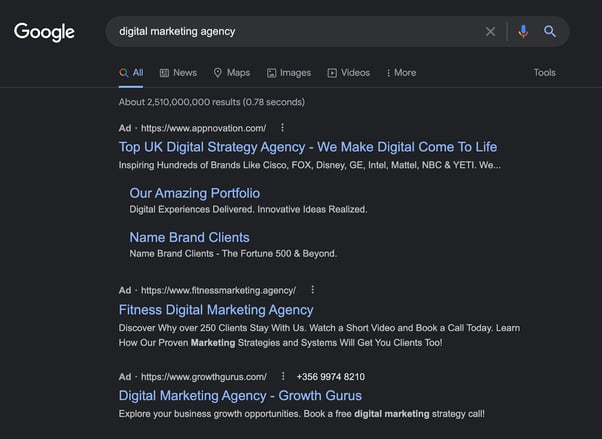
If you want to be really clever, you can even try your hand at ‘reading the SERPs’ or looking at the search results page returned for a particular query to try and work out whether there’s commercial intent behind it.
Google have spent a lot of time and money working out ways to anticipate the intent behind a given search, and while they may not get it right 100% of the time, they are generally pretty close to the mark.
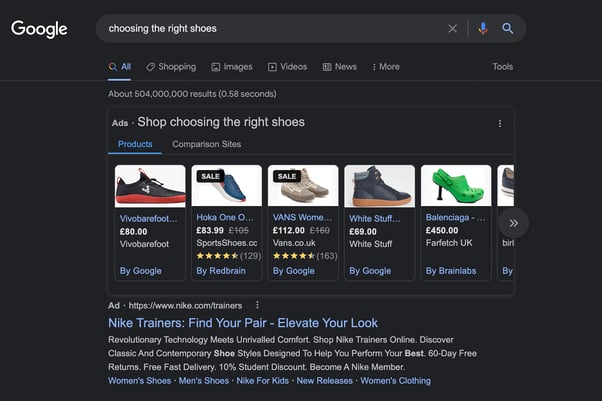
If you Google something like “choosing the right shoe”, you’ll notice that the top of the page is dominated by shoppable ads, and Google’s search filters have been tweaked so that “shopping” comes right after “all results”.
Search for “types of shoe” and you’ll see the opposite: The top of the page is occupied by an organic listing (Wikipedia) and “images” is now the second default filter.
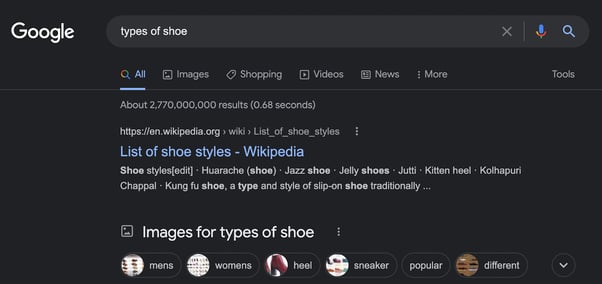
Clearly, Google thinks “choosing the right shoe” has more commercial intent than “types of shoe”, hence the shoppable search results and focus on transactional elements.
Looking out for similar signs can help you spot the opportunities that are most likely to drive paying traffic to your site, and you may find it helpful to run a quick search for any questionable niche keywords: Just to see if Google can give you a steer on their relative value.
But in the interests of total transparency, we’ll be the first to admit that there is no surefire way to measure the intent behind a keyword – niche or otherwise. You can make educated guesses, but there are so many variables at play here, and no one method will prove totally foolproof.
Imagine you’re selling premium toasters, made by a company that employs skilled artisans from the French Riviera. You could spend forever identifying all the “what’s the best toaster” type keywords; optimise content for them and push it live only to find that people who compare toasters are almost always motivated by price and rarely buy luxury goods.
Similarly, you could overlook or dismiss a keyword like “best green toasters”, only to find that the people searching for green toasters almost always slot into the upper-middle class demographic you’re keen to target.
But if you apply a liberal dose of common sense, keep an eye out for interesting opportunities and spend some time evaluating the possible intent behind some target keywords, you should find that you start to build a list of phrases that feel right, and that’s where you’ll want to spend most of your time.
Generally speaking, we find that our initial list of 100-200 potential niche keywords is quickly winnowed down to a list of 30-50 target phrases that are really worth chasing, and there’s nothing wrong with that.
Creating good content takes time. Creating rankable content takes even longer and the last thing you want to do is bog yourself down with a long list of target keywords that obscures the real gems, and distracts you from high-value work.
A worked example: keyword research for a specialist manufacturer
All of this is a bit abstract, so let's walk through what niche keyword research actually looks like in practice. We'll use a fictional (but realistic) example: a company that manufactures bespoke conveyor systems for food processing plants.
First, we'd brainstorm seed keywords. Things like "conveyor systems", "food processing conveyors", "hygienic conveyor belts", "food grade conveyor manufacturer". Nothing clever, just the obvious starting points that describe what the company does.
We'd plug those into SEMRush and immediately see that "conveyor systems" gets decent traffic (around 1,600 searches a month in the UK) but it's very broad. People searching that could be looking for airport baggage conveyors, warehouse automation, mining equipment, anything. Not much use if you only make food-grade systems.
But as we dig into the related keywords, things get more interesting. "Hygienic conveyor belt" gets maybe 90 searches a month. "Food grade conveyor belt" gets around 70. "USDA approved conveyor belt" might only show 20. These are the niche keywords we're after, because every single person searching for those phrases is in our target market.
Next, we'd hit the People Also Ask boxes. Googling "food processing conveyor" surfaces questions like "what conveyors are used in food processing?", "how do you clean a food conveyor belt?" and "what is a modular belt conveyor?". These are content opportunities. Each one could be a blog post that attracts people who are genuinely interested in food-grade conveyor systems.
Then we'd classify by intent. "What is a modular belt conveyor" is informational, great for a blog post. "Food grade conveyor belt manufacturer UK" is transactional, that's a service page. "Modular belt vs flat belt conveyor" is investigational, a comparison guide would work well here.
The final keyword list might only have 30 or 40 phrases on it, and most of them will show low search volumes. But that list represents a focused, realistic content plan that's aimed squarely at the people our fictional company wants to reach. That's what good niche keyword research produces: not a long list of impressive numbers, but a targeted plan that connects your content with the right audience.
Are Your Niche Keywords Too Competitive?
Having assembled a list of target keywords that seems to be
- Popular
- Relevant
- High-intent
You’ll probably be itching to race off and start creating content, but it’s well worth taking a few moments to check how competitive your chosen phrases are meant to be. Now, I want to caveat this section by pointing out that “competitiveness” (as expressed by programmes like Adwords, SEMRush or Ahrefs) has always been a contentious metric. Every platform has its own (proprietary) formula for calculating competition, results are never expressed in the same way and you can tie yourself in knots trying to figure out whether
But in principle, the idea of measuring competitiveness is a sound one: Search engines like Google will always try to rank the best possible content for a given query, and knowing whether you’re up against mom and pop businesses, multinational companies or major news sites can be a tremendous help when you’re trying to work out whether it’s worth going after a given keyword.
Not that we’re saying that you should avoid popular or highly-competitive niche keywords. If your content is good and you optimise a page well, you can often outrank entrenched websites and bring in a steady stream of new leads. But knowing how much work that’s going to take can help you apportion limited resources and prioritise your keyword list properly, which is what we’re recommending here.
In fact, we often assign our own ‘keyword difficulty’ score to keywords; working through our list so that we can go back, and create a content calendar that accounts for the difficulty of various keywords and doesn’t front-load too many ‘slow burn’ articles that’ll take a few months to rank.
It’s also helpful to know what kind of content Google wants to rank for a given phrase. Earlier, we talked about ‘reading the SERPs’ to try and figure out the intent behind a given keyword, but looking at search engine results pages will also help you work out whether Google’s looking to rank blog posts, product landing pages, articles or infographics for a given query – as well as giving you a steer on the amount of content, and level of detail, needed to knock your competitors off the top spot and put your URL at the top of the relevant SERP.
The workflow for this is relatively straightforward: Google your niche keyword, and take a look at the results currently ranking in positions 1-3. Returning to our toaster analogy, we’ll pretend we’re trying to rank for “eco-friendly toaster”. (Very trendy of us, we know).
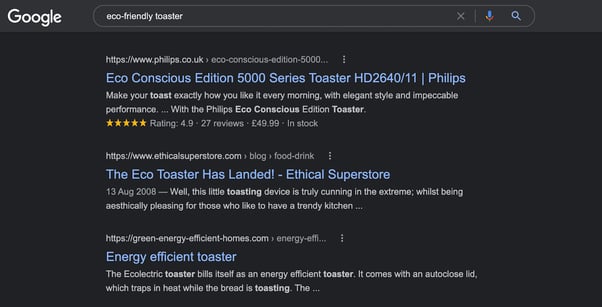
Looking at the top three search results, we can see that we’re trying to out-rank product landing pages that are relatively scant on detail. Plugging the top-ranking Phillips page into a tool like Word Counter shows that it clocks in at a paltry 300 words, and the next 2 results are roughly the same length.
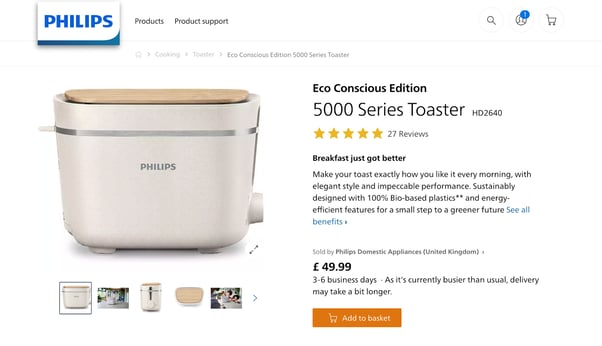 We can also see that the pages have plenty of trust signals (customer reviews), well-optimised headers and video content that we’d want to emulate if we were going to try and steal their top-spot rankings.
I’d also plug all three web pages into Moz’s Link Explorer, SEMRush or a similar tool so I could see what their page and domain authority were; again, giving me a bit of a steer on what it’d take to knock them off the top spot.
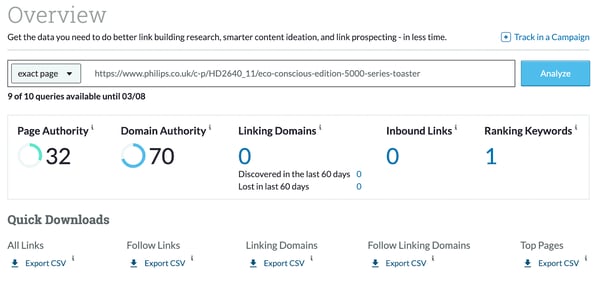 And once you’ve got all of that information to hand, you’ll have a good idea of what you need to create for each of your target keywords. After that, it’s just a matter of creating all the high-value content needed to get you ranking for everything on your final keyword list. But that’s a topic for another article.
What about AI Overviews?
One thing that's changed since we first wrote this guide is the arrival of Google's AI Overviews (those AI-generated summaries that now appear at the top of a lot of search results). If you're doing niche keyword research in 2026, it's worth checking whether your target keywords trigger an AI Overview, because if they do, it means the organic results get pushed further down the page.
That doesn't mean you should avoid those keywords. It just means you need to think about it. For some keywords, the AI Overview actually drives people to click through for more detail, especially when the topic is complex or technical (which is often the case in niche B2B markets). For others, the AI Overview answers the question well enough that fewer people click through to the actual results. Our post on AI search and what it means for B2B covers this in more detail if you want to understand how it affects your SEO strategy.
The practical advice is: Google your target keywords, see what comes up, and factor that into your planning. If a keyword triggers an AI Overview that comprehensively answers the query, you might want to focus on longer, more specific variations where the searcher needs more depth than an AI summary can provide.
And that's pretty much it. Niche keyword research isn't complicated, but it is time consuming, and getting it right makes the difference between content that drives real business and content that sits there gathering digital dust.
If you're working in a specialist market and struggling to figure out which keywords to target, you're not alone. It's one of the most common questions we get from our B2B clients, and it's something we genuinely enjoy helping with because the results are usually so tangible. Finding 20 or 30 keywords that are genuinely being used by your target audience, then building content that ranks for them, is one of the most satisfying things in digital marketing.
If you'd like a hand with it, drop us a line or book a 15-minute chat. We'll take a look at your market, give you an honest assessment of the opportunities and let you know whether we think we can help. No hard sell, no obligations, just a straightforward conversation about your options. And if you want to keep reading in the meantime, our guide to writing SEO-friendly content is a good next step once you've got your keyword list sorted.