 By David Robinson
How to build a lead generation website. Well, strap yourselves in, because this is going to be fun and hopefully something of a voyage of discovery.
Business to business lead generation is the main job most company websites are hired to do, and it's how we, as a B2B web design agency, make our living. Yet in plenty of cases a company's website doesn't generate leads, which leaves the owners scratching their heads wondering why. It's usually a fairly painful process of anger and denial, followed by a desperate scramble for shortcuts, and then a grudging acceptance that actual work needs doing. Sound familiar?
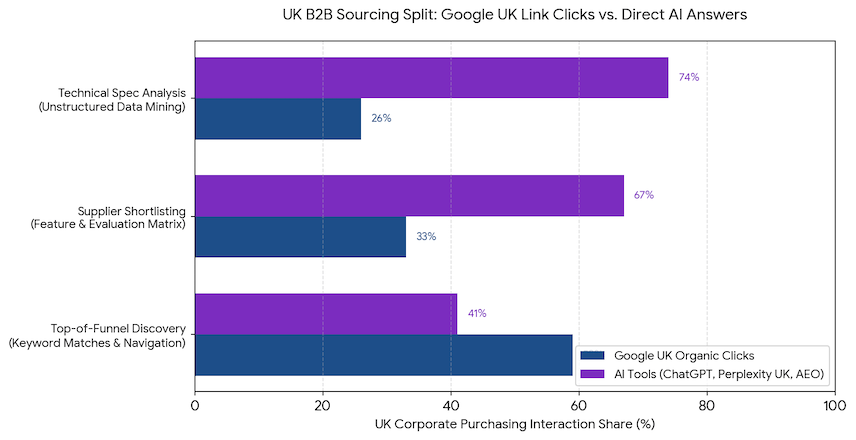
We first published this guide back in 2023, and the bones of it still hold up. Attract, engage, convert. That hasn't changed. What has changed, and changed faster than almost anything we've seen in 20-odd years of doing this, is how people find you in the first place. Your buyers aren't just typing into Google any more. A good chunk of them are asking ChatGPT, Perplexity, or Google's own AI summaries, and getting an answer without ever clicking through to a website at all. So we've given this post a proper overhaul to reflect what we're actually doing for clients now, AI search included.
We've also written an unbiased post on choosing a lead-gen agency for your engineering company.
In this post:
- What we did (and what we got wrong)
- So what's actually changed?
- Step 1: Attract the right visitors
- Step 2: Engage them once they arrive
- Step 3: Convert with patience
- Getting found in AI search (the new bit)
- The technical foundations people forget
- Measuring whether any of it is working
- Why lead generation websites still fail
- What are you waiting for?
- Frequently asked questions
What we did (and what we got wrong)
Back in the day, when Google could be gamed (some might argue it still can), we were caught in a dilemma. Google said "create great content and you'll eventually attract search traffic". Others said "to hell with that, use these blog networks, get links, rank, job done". What to do?
We decided to be the good guys and play by the rules, because the risks of taking the other route seemed too great. In some respects we were lucky, because it meant that way back when we were a fledgling agency, we built a genuine understanding of the virtuous circle that is:
- Identify your customers' problems
- Create content that solves them
- That puts your brand into their thinking
- You win new prospects and clients
Back then we weren't using buzzwords like digital marketing or inbound marketing or even content marketing, and we certainly didn't think of ourselves as solving the problem of how to build a lead generation website. No sir. We were just creating content that solved people's problems.
And here's the honest bit: for a good while, following the rules didn't really work. The gamers were in full swing, seeding links on private blog networks and shoving their pages up the rankings, while honest website owners got buried. It was a testing time, watching others flourish on content we knew was thin, all the while knowing they were getting there by cheating. Grrrr. If you're not sure why that worked, our guide on what link building actually is is worth a read.
Thankfully, the days of rampant search engine gaming are mostly behind us. There are still people out there using nasty techniques to rank, hacking websites to plant links and the like, but for the most part, playing by the rules now works. The patient approach won. It just took a while.
So what's actually changed?
The three-step framework we'll walk through is the same one we've trusted for years. Attract people, engage them, convert them. If you only take one thing from this post, take that.
What's moved on is the detail underneath each step, and it's moved on a lot. Buyers do more of their research before they ever speak to you. A B2B purchase might involve six or seven people inside a business, all poking around your site at different times for different reasons. Google rewards genuinely useful, experience-led content far more than it used to. And, of course, a meaningful slice of your audience now gets their answers from an AI assistant rather than a list of blue links.
None of that breaks the model. It just means the way you attract, engage and convert has to be a bit smarter than it was in 2023. So here's how to build a lead generation website, in three "simple" steps, plus the new realities you can't ignore.
Step 1: Attract the right visitors
For a website to generate leads it needs to attract the right visitors, by which we mean people who actually need what you sell. Attracting the wrong people in their thousands does nothing except flatter your analytics. There are essentially two ways to do it.
- Buy attention (Google Ads, paid social, PR, sponsorship)
- Earn attention (strong search rankings from genuinely useful content, pulling in a steady stream of the right traffic)
The first one works, and if you've got the budget it's a fast route to leads. Google Ads will reliably send relevant traffic your way, but you pay for every single click, including the people who land, look, and leave without so much as a hello. The cost never stops while the campaign is running.
The second is the one we prefer. It's all about creating content that earns lasting rankings and a flow of visitors who keep arriving long after the work is done. It's hard work, it's not instant, but the long-term results can be spectacular. The honest trade-off is patience, and if you want a realistic sense of the timescales, we've written about how long B2B SEO actually takes rather than the fantasy figures some agencies quote.
Start with keyword research, not opinions
To work out what your content should cover, you start with keyword research. This tells you what your potential customers are genuinely typing into Google, as opposed to what you assume they're typing, which is usually different and often a bit too clever. From there you decide which phrases are worth chasing, balancing search volume against how realistic it is to compete. Going head to head with a giant national brand on a fiercely contested term is rarely the smart opening move.
If keyword research is new to you, our foolproof methodology for finding the right keywords walks through the whole thing, and if you just want the basics first, SEO explained in plain English is a gentler starting point.
Match the content to the search, and to the buyer's stage
Not every search deserves the same response. Someone typing "what is X" is at the very start of their thinking and wants a clear explanation. Someone typing "X supplier for offshore projects" is much closer to spending money. A lead generation website needs content for both ends of that spectrum, and the bits in between, which is exactly why a handful of pages will never cut it.
The format matters too. Some topics are best served by a thorough written guide, others by a video, a calculator, or a downloadable checklist. If you want a sense of what good looks like on the page itself, our guidance on writing SEO-friendly content covers how to structure it so both people and search engines get on with it. For engineering and technical firms specifically, content marketing for engineering companies is the one to read.
So step one is done. You've done the research, created the content, and traffic is starting to build. There's more to it than that one paragraph suggests, but in essence that's what's happening.
At this stage, it's worth considering experimenting with LeadInfo to see which companies are looking at your website.
Step 2: Engage them once they arrive
I've got to be honest, this is the bit we missed for a long time. We assumed that if people found our website, they'd simply click the contact page or pick up the phone, and bingo, new client. But no. There's a lot more to it.
Sure, every now and then someone finds you in Google, you're the precise answer to their prayers, and you land the work there and then. Lovely when it happens. It just doesn't happen very often. Most of the time the visitor is curious rather than ready, and if your only call to action is "contact us", you'll watch the overwhelming majority leave without a trace.
More commonly, having attracted a visitor, you now need to engage them with an offer that genuinely resonates. For us that might be a website review, an inbound assessment, an e-book, or a subscription to the blog. What's right for you depends entirely on your market. A SaaS vendor might offer a free trial. A lawyer might offer a free initial consultation. You get the picture.
The point of all of it is the same: give people a reason to tell you who they are. Once they've granted you permission to stay in touch, you've engaged them, and you can start the patient work of turning them into a client. If you want a structured way to audit whether your site is set up to do this, our web-based lead generation checklist is a useful run-through.
Make the offer easy to say yes to
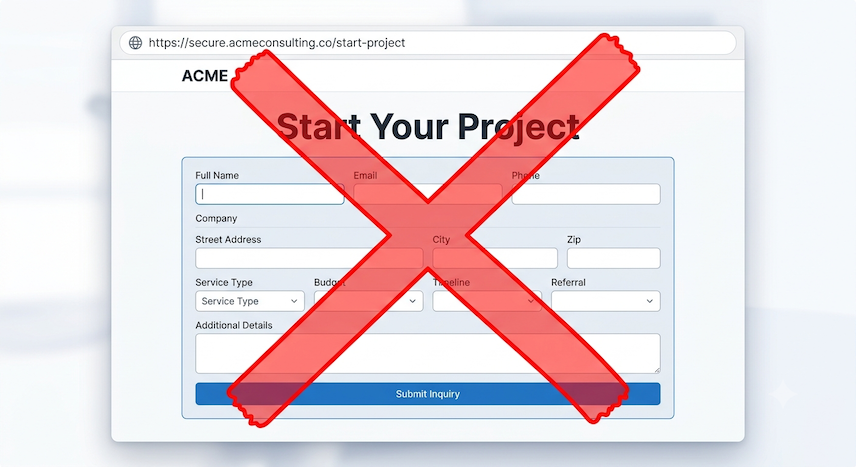
One quiet killer of engagement is friction. A form that demands twelve fields when three would do. An e-book hidden behind a wall of jargon. A "book a demo" button when the visitor only wanted a price guide. The bigger the ask, the more certain the visitor needs to be, and most of them aren't there yet. Lower the bar at the top of the funnel and you'll capture far more of the people who'd otherwise have drifted off.
Step 3: Convert with patience
It's rarely the case that you'll convert a prospect by simply calling them up. Think about it. At this point they've found you in Google and filled in a form to take you up on an offer. They don't really know you, they don't yet trust you, and jumping straight on the phone is a good way to send them running for the hills. As a wise man once put it, you've got to "play it nice and cool, son, you know what I mean".
This phase is known as lead nurturing, which is old news to sales and marketing folk, but to us lowly engineers it was a concept that took some getting used to. It's about building trust, steadily adding value, and gently keeping yourself in the prospect's mind so that when they're finally ready to buy, you're firmly on the shortlist of suppliers they consider.
Getting this right depends on understanding which stage of the buyer journey your prospect is at, which is exactly why you need content for each of those stages. Early on they want education and reassurance. Later they want proof, case studies, comparisons, and a sense of what working with you is actually like. Fire a hard sell at someone in the education phase and you'll lose them. Withhold the proof from someone who's ready to decide and you'll lose them too.
In B2B this matters even more, because the buying decision usually isn't made by one person. There's the researcher, the budget holder, the sceptic in operations, the person who'll actually use what you sell. Your content has to quietly win over a small committee, often without you ever knowing it's happening. We've dug into this in more detail in our piece on marketing for complex B2B sales cycles, and it's a big part of why a "set and forget" website rarely delivers.
Getting found in AI search (the new bit)
Here's the development that's genuinely reshaped this conversation since we first wrote the post. A large and growing share of your buyers no longer start with a Google search and a page of blue links. They ask a question of ChatGPT, Perplexity, Gemini, or Google's own AI Overviews, and they get a written answer, often with a couple of sources named and the rest left invisible. Whole research journeys now happen without anyone clicking through to a single website.
For a lead generation website, that's a big deal. If the AI assistant your prospect is chatting to never mentions you, you're not on the shortlist, and you may never even know the conversation took place. The reassuring news is that the work which gets you cited in AI answers overlaps heavily with the work that's always made good websites rank. The unsettling news is that it isn't identical, and a few specifics now matter more than they used to.
Answer real questions clearly and directly
AI models love content that states an answer plainly and then backs it up. Pages that bury the point under 600 words of throat-clearing get skimmed over. So lead with the answer, use clear headings that mirror the questions people actually ask, and write in a way that a machine can lift a clean, quotable sentence from. Funnily enough, that's also exactly what human readers want, so you're not trading one audience for the other.
Build the kind of authority models trust
AI engines lean on signals of genuine expertise and reputation when they decide who to cite. Original insight, real experience, named authors, consistent information about your business across the web, and mentions on sources the model already trusts all help. Thin, me-too content that simply restates what everyone else says gives an AI no reason to pick you out. This is where having an actual point of view, the thing we've banged on about for years, finally pays off twice.
Don't neglect the plumbing
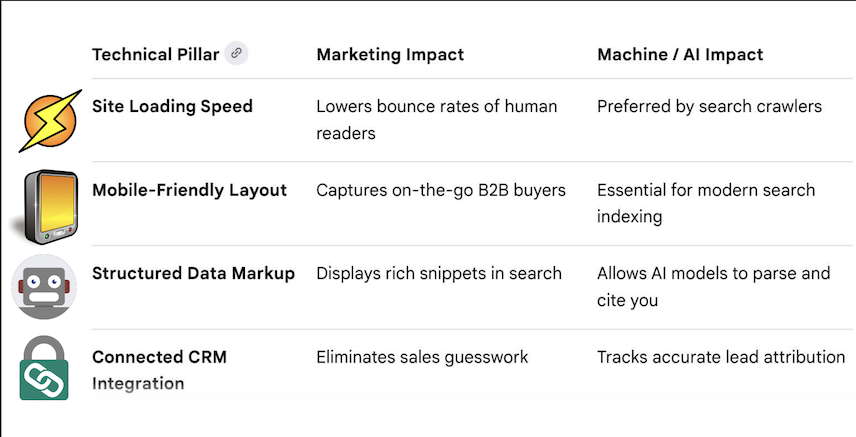
If AI crawlers can't read your site, you can't be cited, full stop. Clean structure, sensible headings, fast loading, and structured data (the behind-the-scenes markup that tells machines what a page is about) all make it easier for these systems to understand and quote you. It's the same housekeeping that helps Google, done with a bit more care.
We've written about this shift in proper depth, so rather than cram it all in here, have a read of AI search and B2B: what engineering companies need to know and our wider AI search strategy for marketers. The headline is simple enough: AI search rewards the businesses that were already doing the honest, useful work, and it quietly punishes the ones hoping to coast. We're rather pleased about that.
The technical foundations people forget
You can do everything above brilliantly and still leak leads if the website itself is a chore to use. It's the least glamorous part of the job, which is precisely why so many sites get it wrong.
Speed is the obvious one. If a page takes an age to load, a sizeable chunk of visitors leave before they've seen a word of your carefully crafted content. Mobile is the other. A large share of B2B research now happens on a phone, often a quick check between meetings, and a site that's fiddly on mobile quietly costs you enquiries you'll never see in a report.
Then there's structure. Clear navigation, sensible page hierarchy, obvious next steps on every page. A visitor should never have to wonder where to go or what to do. And running underneath all of it should be a decent CRM capturing who does what on your site, because guesswork is no way to improve. We almost always point people towards HubSpot's CRM for exactly this reason, though the principle matters more than the specific tool.
The smart way to handle all of this is to stop treating your website as a thing you build once and forget. We're firm believers in growth-driven design, where you launch a solid site and then keep improving it based on real visitor behaviour, rather than blowing the entire budget on a big-bang rebuild every three years and crossing your fingers.
Measuring whether any of it is working
Here's a trap we see constantly: businesses measuring the wrong thing and feeling either falsely cheerful or needlessly miserable as a result. Traffic going up is nice, but traffic is not the goal. Leads are the goal. Good leads, ideally, the sort that turn into actual revenue.
So track the numbers that connect to money. How many visitors turn into leads. Where those leads come from, organic search, AI referrals, paid, direct, referral. Which pages and which offers do the heavy lifting. How many leads go on to become genuine sales conversations, and eventually customers. A page pulling in huge traffic but converting nobody is telling you something useful, and so is a quiet page that converts almost everyone who lands on it.
One newer wrinkle: AI assistants sometimes send people to you without the usual fingerprints, so a prospect who says "I asked ChatGPT and your name came up" might land in your analytics simply as direct traffic. Don't ignore that channel just because it's harder to measure. Ask new enquiries how they found you, because the answer is increasingly interesting, and increasingly not Google.
Why lead generation websites still fail
After 20 years of this, the reasons sites fail to generate leads are wearily predictable, and almost always one of a handful.
The most common by a distance is doing step one and stopping. Plenty of sites attract visitors perfectly well, then offer them nothing but a contact form and wonder why nobody bites. Attracting without engaging or converting is like filling a bath with the plug out.
Close behind is impatience. Earning rankings and trust takes months, not days, and we've watched more than one business pull the plug on a strategy three weeks before it would have started paying off. There's also the opposite failure, building lovely content nobody's actually searching for, which is what happens when you skip the keyword research and go with gut feel.
And then there's the website that's simply unpleasant to use, slow, confusing, awkward on a phone, so that all the good work upstream drains away at the final hurdle. If any of that stings a little, you're in good company, and the fix is rarely as daunting as it first looks.

What are you waiting for?
By now you should have a fair grasp of how to build a lead generation website. In essence you need a range of genuinely useful content targeting the phrases your potential customers actually search for, ways to engage the visitors that content brings in, and a patient plan for converting them into customers. On top of that, you now need to make sure you're visible in the AI tools an increasing number of your buyers ask before they ask anyone else.
It's a daunting prospect when you're setting out, no question. But you don't have to do all of it at once, and starting the process now genuinely does take you one step closer. If you'd like a hand, we're a web design agency in Aberdeen with all the skills to give your website a proper shot at success. There's no hard sell, and if we think you're better off saving your money, we'll tell you that too. A quick, no-pressure chat is usually the easiest place to begin.
Frequently asked questions
What are the three steps to building a lead generation website?
The three steps are attract, engage, and convert. First, attract the right visitors through either paid advertising or earned organic traffic from genuinely useful content. Second, engage those visitors with relevant offers that give them a reason to share their contact details. Third, convert them through lead nurturing, building trust over time until they're ready to buy. Skip any one of the three and the website tends not to generate leads.
How does AI search change lead generation websites?
More buyers now get answers from ChatGPT, Perplexity, Gemini and Google's AI Overviews without clicking through to a website. If those tools never mention your business, you won't appear on the buyer's shortlist. To get cited, you need content that answers real questions clearly and directly, genuine signals of expertise and reputation, and a technically clean site that AI crawlers can read. Reassuringly, this overlaps heavily with the honest, useful content work that has always helped sites rank in Google.
Should I pay for website traffic or focus on organic SEO?
Both work, but they suit different situations. Paid advertising such as Google Ads delivers fast results but costs money for every click, including the visitors who never enquire. Organic SEO through content creation takes longer but delivers lasting results and a steady flow of visitors without ongoing ad spend. Most B2B companies benefit from a sensible combination of the two, using paid for speed while organic builds underneath it.
Why isn't my website generating leads?
Most websites fail to generate leads because they only attract visitors without engaging or converting them. Traffic alone isn't enough. You need compelling offers that give visitors a reason to identify themselves, plus a lead nurturing process that builds trust before you attempt to sell. Other common culprits are impatience, content nobody is actually searching for, and a site that's slow or awkward to use, especially on a phone.
How long does it take to build a lead generation website?
Building a lead generation website is a long game rather than a quick fix. Launching the site itself might take weeks, but creating content that ranks in search, gets cited in AI answers and generates a consistent flow of leads usually takes months. The results compound over time, so starting now matters more than waiting for the perfect moment. Pulling the plug too early is one of the most common and costly mistakes we see.
What is lead nurturing and why does it matter?
Lead nurturing is the process of building trust with prospects before attempting to sell to them. When someone first finds your website, they don't know or trust you yet, so a sales call out of nowhere often pushes them away. Instead you provide content for each stage of the buyer journey that adds value and keeps you in their mind until they're ready to buy. In B2B this matters even more, because the decision is usually made by several people inside a business rather than one.